Strength Adaptations in Hypocaloric States: Research Data
Longitudinal observations of strength changes during energy restriction combined with resistance training.
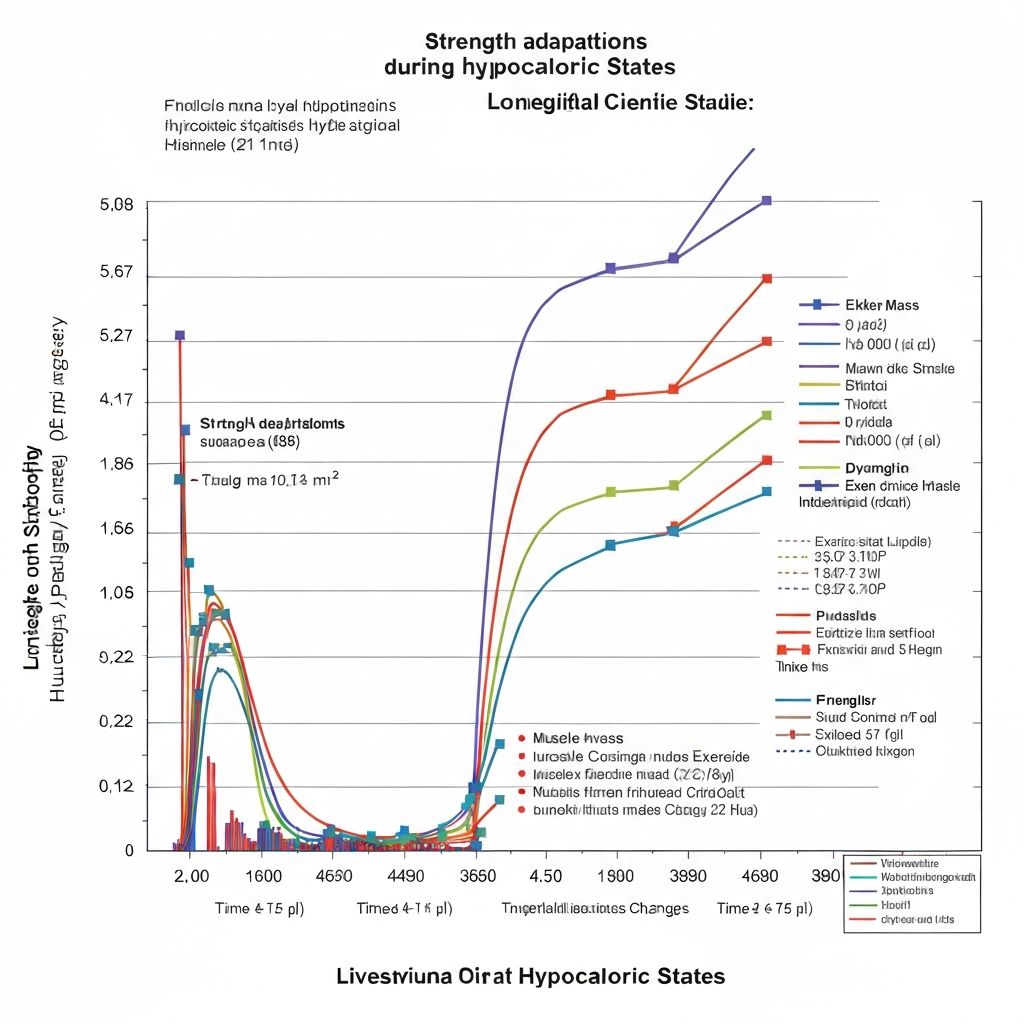
Strength Maintenance During Energy Deficit
Strength—the maximum force the neuromuscular system can generate—depends on multiple factors including muscle mass, neural coordination, contractile protein quality, and central nervous system drive. Energy deficit creates conditions that theoretically challenge strength maintenance by reducing available substrates and increasing overall catabolic processes.
However, longitudinal research consistently demonstrates that strength maintenance or modest improvement occurs during energy deficit when resistance training is maintained. This observation has emerged across numerous controlled trials spanning different populations, deficit magnitudes, and training protocols.
Key Research Observations
Studies examining 8–12 week interventions combining energy deficit (500–750 kcal/day) with resistance training typically report:
- Strength gains of 2–8% (assessed via maximal voluntary contraction or 1-repetition maximum)
- Modest lean mass losses of 1–4% (despite training)
- Fat mass losses of 5–15% (highly dependent on deficit magnitude and duration)
The apparent paradox—that strength improves despite modest lean mass loss—reveals that strength depends more on neural factors and contractile protein quality than on absolute muscle mass in the short-to-intermediate term.
Neural Adaptation and Movement Quality
A substantial proportion of strength gains in the initial weeks of resistance training stems from neural adaptations rather than hypertrophy. Neural adaptations include improved motor unit recruitment, enhanced synchronisation of motor units, and reduced antagonist muscle co-activation. These factors can be optimised during energy deficit because they depend on neural learning and coordination rather than on substrate availability.
Continued training during energy deficit maintains neural pathways and permits progressive optimisation of movement patterns. This neural component can drive 2–5% strength improvements even when muscle mass is stagnant or slightly declining.
Contractile Protein Composition Changes
Research utilising muscle biopsies has demonstrated shifts in contractile protein composition during energy deficit with training. Specifically, the ratio of myosin heavy chain (MHC) isoforms may shift toward faster, more powerful isoforms (MHC II types) and away from oxidative types. This preferential preservation or shift of contractile protein composition can enhance force generation capacity independent of mass.
Additionally, trained muscle during deficit may experience remodelling of the extracellular matrix and neuromuscular junction structure, which can optimise force transmission efficiency. These qualitative changes may partially compensate for modest mass reductions in determining absolute strength output.
Metabolic Efficiency and Fatigue Resistance
Energy deficit combined with repeated resistance training stimulates mitochondrial adaptations including increased oxidative capacity and enhanced substrate utilisation efficiency. These adaptations may enhance strength endurance—the capacity to maintain submaximal force over multiple repetitions—even if peak strength shows minimal change.
Improved metabolic efficiency also delays central nervous system fatigue during training, potentially allowing individuals to maintain higher training intensity (relative load) throughout a training session despite overall reduced energy availability. This preserved training quality may support strength maintenance better than would otherwise be expected.
Deficit Magnitude and Duration Effects
Strength outcomes become progressively less favourable with increasing deficit magnitude and duration. Moderate deficits (15–20% below maintenance) show the most favourable strength maintenance. Severe deficits (30–40% below maintenance) show smaller strength gains or maintenance. Very severe deficits (greater than 45%) often result in strength stagnation or decline despite training.
Similarly, interventions lasting 4–8 weeks typically show strength improvements. Longer interventions (16–24 weeks) show progressive attenuation of strength gains, particularly in moderate-to-high deficit conditions, suggesting that the protective effect of training has practical limits.
Individual Variability and Training Status
Strength outcomes during energy deficit vary substantially by training status. Untrained or novice individuals show the most robust strength improvements during deficit, often gaining 5–10% over 8–12 weeks. Intermediate-trained individuals show modest improvements (2–5%). Advanced-trained individuals with prior strength training experience often show strength stagnation or minor losses during energy deficit despite continued training.
This pattern reflects the law of diminishing returns: novice trainers benefit from substantial neural adaptation, which is relatively resistant to energy deficit. Advanced trainers, whose neural systems are already optimised, derive strength gains primarily from hypertrophy-related mechanisms, which are substantially impaired by energy deficit.
Important Limitations and Context
This article summarises research observations. Content is informational only and does not constitute personal training or nutritional recommendations. Individual responses vary based on training history and other factors. For decisions regarding training, consult qualified professionals.