Energy Expenditure Contribution from Resistance Training
Quantification of acute and chronic energy cost effects from resistance exercise.
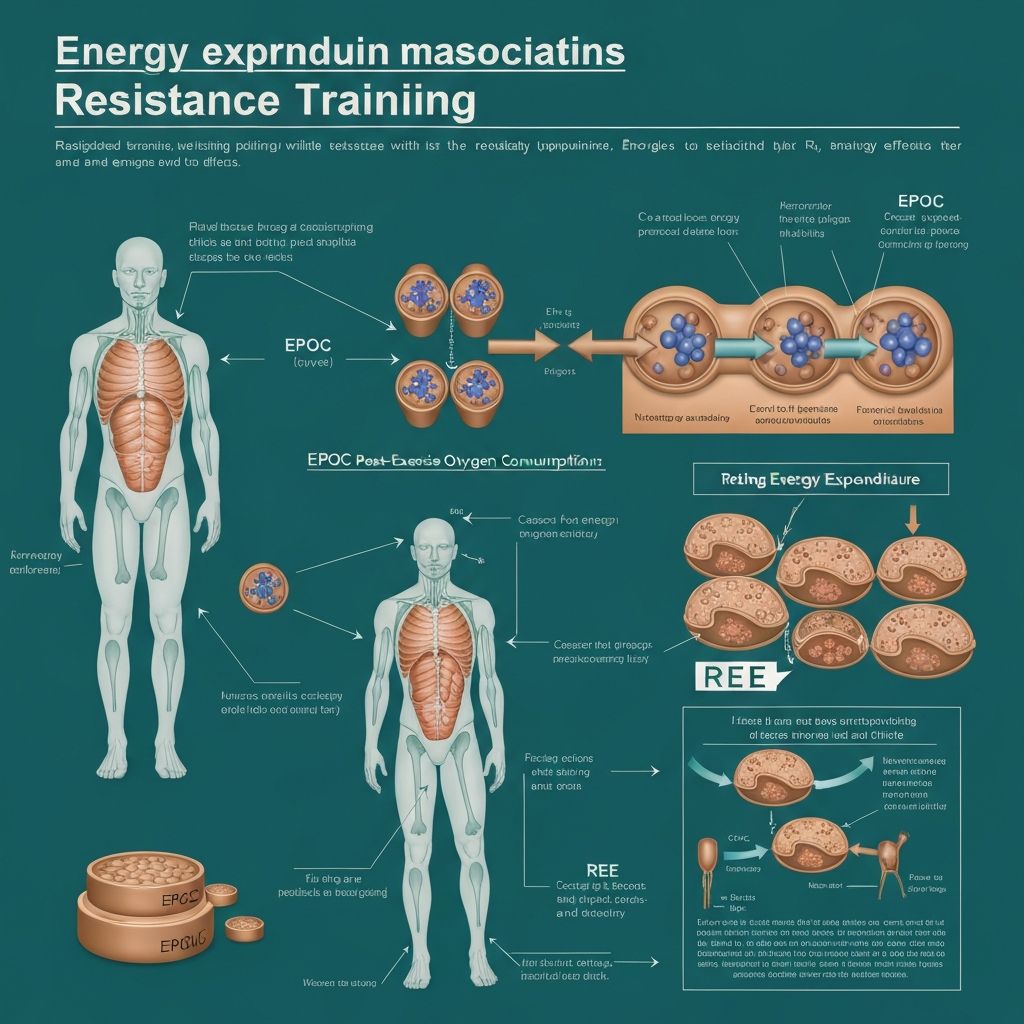
Components of Total Daily Energy Expenditure
Total daily energy expenditure (TDEE) comprises three primary components: basal metabolic rate (BMR) or resting metabolic rate (RMR), thermic effect of food (TEF), and activity energy expenditure (AEE). Resistance training affects multiple components of this total.
The acute energy cost of a single resistance training session contributes directly to daily activity energy expenditure. The excess post-exercise oxygen consumption (EPOC) extends energy expenditure into the recovery period following training. Over weeks and months, chronic adaptations including increased muscle mass and oxidative capacity elevate resting metabolic rate.
Acute Exercise Energy Cost
During a resistance training session, the body expends energy at elevated rates to support muscle contraction, ATP hydrolysis, and associated physiological processes. A typical 60-minute resistance training session expends approximately 200–400 kilocalories, depending on exercise intensity, volume, muscle mass engaged, and individual metabolic characteristics.
Higher training intensity (heavier loads, shorter rest periods, higher movement velocity) correlates with greater acute energy expenditure. Similarly, exercises engaging large muscle groups (squats, deadlifts, rows) consume more total energy than smaller isolation movements. Body composition also influences this: individuals with greater existing muscle mass typically expend more energy during resistance training at equivalent intensity levels.
Excess Post-Exercise Oxygen Consumption
EPOC, also called "afterburn," refers to the elevated metabolic rate persisting after exercise cessation. During recovery, multiple processes consume ATP: phosphocreatine resynthesis, lactate clearance, body temperature normalisation, immune system activation, and anabolic processes associated with adaptation signalling.
EPOC magnitude depends on exercise intensity and volume. Resistance training typically generates EPOC lasting 4–48 hours post-exercise, with higher intensity training generating more prolonged elevation. Research estimates that EPOC contributes an additional 10–20% above the acute exercise energy cost. For a 300 kilocalorie acute exercise session, EPOC might contribute 30–60 additional kilocalories over the recovery period.
Importantly, the magnitude of EPOC is not proportional to exercise duration. A shorter, higher-intensity resistance session may generate greater EPOC than a longer, lower-intensity session consuming equivalent acute energy. This principle explains why high-intensity training contributes disproportionately to total daily energy expenditure.
Chronic Elevation of Resting Metabolic Rate
Chronic resistance training adaptations elevate resting metabolic rate (RMR). Muscle tissue is metabolically active; at rest, each kilogram of muscle tissue consumes approximately 5–6 kilocalories daily, whilst fat tissue consumes approximately 2 kilocalories per kilogram daily. Resistance training-induced hypertrophy therefore directly increases baseline metabolic rate.
Additionally, resistance training enhances mitochondrial density and oxidative enzyme capacity within muscle tissue. These adaptations increase the energy demand of muscle tissue independent of mass gain. Enhanced mitochondrial function and oxidative capacity elevate RMR by approximately 5–10% over 8–12 weeks of consistent resistance training.
Combined effects of modest hypertrophy (1–2 kg lean mass gain) plus enhanced oxidative capacity can increase RMR by 50–100 kilocalories daily. Over a week, this represents 350–700 additional kilocalories expended; over a year, this compounds to substantial differences in total annual energy expenditure.
Energy Expenditure During Caloric Deficit
Interestingly, resistance training during energy deficit may generate slightly greater acute energy expenditure than training in energy-replete states, due to additional mobilisation of intracellular energy stores and increased sympathetic nervous system activation. However, chronic adaptations may be slightly attenuated under energy restriction, as the body allocates limited resources toward survival-related processes rather than mitochondrial biogenesis.
Despite these nuances, resistance training remains an effective tool for contributing to energy deficit magnitude during caloric restriction. The combined acute + EPOC energy cost of resistance training typically represents 10–15% of daily caloric expenditure in individuals engaging in regular training, making it a meaningful contributor to overall deficit.
Metabolic Adaptation and Compensatory Mechanisms
Prolonged energy deficit triggers compensatory mechanisms including reduced physical activity, increased appetite signalling, and slight downregulation of metabolic rate. These adaptations partially offset the energy deficit created by training and dietary restriction. However, resistance training appears to partially attenuate metabolic adaptation by maintaining muscle tissue, which otherwise would be lost and contribute to reduced energy expenditure.
This protective effect of resistance training on metabolic rate represents an indirect contribution to deficit sustainability. Without training, extended deficits trigger progressive metabolic rate reductions of 10–20%. Resistance training reduces this adaptation, helping to preserve the deficit over longer periods.
Practical Implications
From an energy expenditure perspective, resistance training contributes to daily energy expenditure through multiple mechanisms operating across different timescales. A single session contributes acute + EPOC energy; repeated sessions over weeks accumulate chronic adaptations elevating baseline expenditure. These effects compound: higher daily activity energy expenditure permits greater deficit magnitude for equivalent dietary restriction, or permits greater dietary flexibility for equivalent deficit.
For individuals in energy deficit, maintaining or increasing resistance training volume and intensity preserves these expenditure-elevating benefits. Reducing training during deficit eliminates these contributions, requiring either greater dietary restriction or acceptance of smaller deficit magnitude to achieve equivalent results.
Important Limitations and Context
This article presents educational information on energy metabolism. Content is informational only and does not constitute personal nutritional or exercise recommendations. Individual metabolic responses vary. For decisions regarding diet or training, consult qualified professionals.